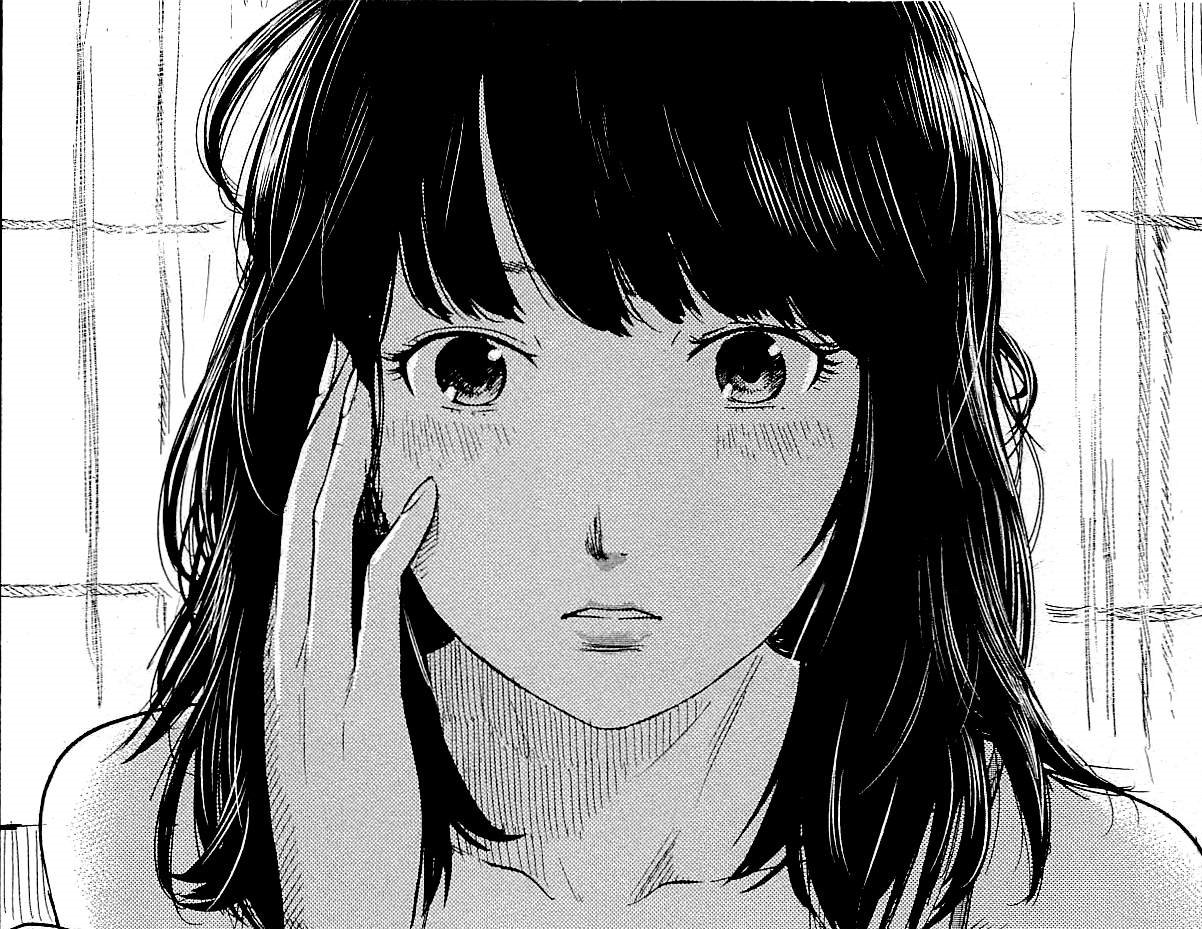
Shūzō Oshimi's Inside Mari begins as a bizarre body-swap mystery. But beneath its unsettling premise lies something far more heartbreaking: the story of a person who has spent so long living for everyone else that she no longer knows who she really is.
Imagine waking up one morning and discovering that you've become someone else.
You look into the mirror, but the face staring back isn't yours.
Your surroundings are unfamiliar. Your voice sounds different. Even your own body feels like something that doesn't belong to you.
Everyone around you recognizes the person you're supposed to be.
Your family treats you normally. Your classmates expect you to behave as you always have. Your friends assume you're the same person they've always known.
But you have no idea who that person is.
It's a terrifying premise.
And it's how Inside Mari, the psychological manga written and illustrated by Shūzō Oshimi, begins.
Serialized in Manga Action between 2012 and 2016 and collected into nine volumes, Inside Mari initially presents itself as a disturbing variation of the familiar body-swap story.
But anyone expecting a lighthearted comedy about a man suddenly experiencing life as a teenage girl is in for a surprise.
Because Inside Mari isn't particularly interested in the novelty of switching bodies.
It's interested in what happens when a person becomes a stranger to themselves.
And as its mystery gradually unfolds, the story reveals something considerably more disturbing than any supernatural explanation.
Perhaps the most frightening thing isn't waking up as someone else. Perhaps it's realizing that you've never been allowed to be yourself.
A Man Who Wakes Up as a Teenage Girl
Inside Mari begins by introducing Isao Komori.
He's a college dropout who has withdrawn almost entirely from ordinary society.
He spends his days isolated in his apartment, playing video games, avoiding responsibilities, and drifting through a life that seems to be going nowhere.
He has few meaningful connections and little motivation to change his circumstances.
But there's one particular routine that brings him a strange sense of comfort.
Every night, he visits a convenience store where he frequently sees a beautiful high school girl named Mari Yoshizaki.
Komori becomes fixated on her.
He watches her, follows her, and constructs an idealized image of someone he doesn't actually know.
Then, one morning, everything changes.
Komori awakens in Mari's body.
He's no longer the isolated young man who spends his days avoiding the outside world.
He's a teenage girl with a family, friends, school responsibilities, and an entirely different social existence.
Naturally, he assumes some extraordinary supernatural event has occurred.
Perhaps their bodies have been exchanged.
Perhaps Mari is now living inside his original body.
But when he eventually encounters the real Komori, something doesn't make sense.
The man occupying Komori's body appears to be living his ordinary life.
And he doesn't recognize Mari.
There is no obvious evidence that the two have exchanged places.
So where did Mari go?
And if Komori is still living inside his original body, then who exactly is the person we've been following?
It's an exceptionally compelling mystery.
But what makes Inside Mari so disturbing isn't simply the uncertainty surrounding its protagonist.
It's the growing realization that nearly everyone involved possesses an incomplete understanding of Mari herself.
Everyone Knows Mari. Nobody Really Knows Her.
From the outside, Mari appears to possess the kind of life that other people might envy.
She's attractive, popular, and seemingly well-adjusted.
She has friends, attends school, and maintains the outward appearance of an ordinary teenage girl.
To Komori, she represents something almost unattainable.
A beautiful stranger whose seemingly perfect life stands in complete contrast to his own miserable existence.
But there's an obvious problem with his perception.
He doesn't know anything meaningful about her.
He watches her from a distance and fills in the gaps with his own imagination.
He doesn't understand her relationships.
He doesn't know what happens inside her home.
He has no idea what she's afraid of, what she regrets, or what she might secretly wish for.
And yet, he believes he understands something about who she is.
That contradiction becomes one of the manga's most important ideas.
We often think we know people when, in reality, we only know the version of them that we've constructed in our own minds.
Someone might appear cheerful and confident while privately struggling with overwhelming insecurity.
A person surrounded by friends might feel profoundly lonely.
Someone who seems to possess everything another person wants might secretly dream of escaping their own life.
But those experiences aren't necessarily visible to outsiders.
We see appearances.
We observe behavior.
And we construct explanations based on what little information we possess.
Inside Mari explores how dangerous that process can become when we mistake our assumptions for someone's actual identity.
Because Mari isn't simply being observed.
She's being defined by other people.
And eventually, the expectations surrounding her become impossible to separate from the person she believes herself to be.
The Horror of Living Someone Else's Life
One of Inside Mari's greatest strengths is its ability to turn ordinary experiences into something profoundly uncomfortable.
Going to school becomes terrifying.
Speaking to classmates feels dangerous.
Interacting with family members requires constant vigilance.
Even the most mundane aspects of daily life become sources of anxiety.
The apparent Komori doesn't know how Mari normally behaves.
He doesn't understand the relationships he's expected to maintain.
And every conversation carries the possibility that someone will recognize something is wrong.
It's a deeply claustrophobic experience.
But what's particularly unsettling is how familiar that anxiety can feel.
Because the fear of failing to meet other people's expectations isn't limited to fictional body-swap scenarios.
Many people spend portions of their lives attempting to become the person others want them to be.
They change their behavior to avoid criticism.
They suppress opinions to maintain friendships.
They pursue ambitions chosen by their parents.
They conceal parts of themselves because they're afraid those qualities won't be accepted.
And after enough time, maintaining that performance can begin to feel automatic.
You become skilled at giving people the responses they expect.
You learn which emotions are acceptable.
You discover how to make yourself pleasant, agreeable, and easy to understand.
But somewhere beneath that performance, an uncomfortable question remains.
If everyone likes the person you're pretending to be, does anyone actually know you?
Inside Mari takes that anxiety and turns it into the central experience of its protagonist.
The horror isn't merely being trapped in an unfamiliar body.
It's being trapped inside an identity that everyone else insists belongs to you.
Yori Kakiguchi: The Person Who Sees Something Is Wrong
As the mystery develops, another character becomes increasingly important.
Yori Kakiguchi.
A quiet, socially awkward classmate who recognizes that something about Mari has changed.
Unlike the people who accept Mari's unusual behavior without seriously questioning it, Yori begins noticing inconsistencies.
She becomes involved in the search for the missing Mari, eventually forming an unusual relationship with the person claiming to be Komori.
Their interactions provide some of the manga's most compelling moments.
There's discomfort, suspicion, curiosity, and a growing sense of emotional intimacy.
But Yori isn't simply an outsider who understands Mari better than everyone else.
Her own feelings complicate the situation.
She has developed an intense attachment to Mari, and her perception of the girl is shaped by admiration, desire, and insecurity.
In some ways, this makes her surprisingly similar to Komori.
Both have watched Mari.
Both have imagined what kind of person she must be.
And both struggle when the person standing before them doesn't match the version they've constructed in their minds.
That parallel is essential.
Because Inside Mari isn't merely criticizing an isolated young man for obsessing over a girl he doesn't know.
It's examining the broader tendency to turn other people into reflections of our own desires.
Sometimes, we admire someone so intensely that we stop seeing their flaws.
Sometimes, we become attached to a particular version of a person and struggle when they begin to change.
And sometimes, we fall in love with the idea of someone more than the actual individual.
Yori wants to find Mari. But part of her struggle involves understanding whether she ever truly knew Mari to begin with.
It's a painful distinction.
And as the story moves toward its conclusion, it becomes increasingly important.
The Mystery Is Only the Beginning
One of the most remarkable things about Inside Mari is how dramatically its meaning changes as you read.
Initially, the question appears straightforward.
What happened to Mari?
Where did her consciousness disappear?
Why is Komori apparently occupying her body when his original self continues living normally?
The manga encourages us to search for an explanation involving supernatural phenomena.
But the further the story progresses, the more difficult that interpretation becomes to maintain.
Unexplained memories begin surfacing.
Contradictions emerge.
And details that initially seemed unimportant gradually become essential to understanding the truth.
The reader begins questioning not only the circumstances surrounding Mari's disappearance, but the reliability of the perspective through which those circumstances have been presented.
It's a clever use of psychological mystery.
Oshimi doesn't simply hide information.
He constructs a narrative in which the assumptions we bring to the story become part of the deception.
We accept that we're following Komori because the story introduces us to his perspective.
We assume Mari has disappeared because the protagonist tells us she has.
But what if the explanation we've accepted from the beginning is fundamentally wrong?
What if the person telling the story doesn't understand their own existence?
And what if the real mystery isn't where Mari went?
What if the real mystery is why Mari no longer knows who she is?
The Truth About Mari
Major spoilers for the entire manga follow.
The central revelation of Inside Mari completely transforms our understanding of its premise.
There was no supernatural body swap.
The real Isao Komori never suddenly awakened inside Mari's body.
The person we've been following isn't the actual Komori displaced from his own life.
Instead, the story reveals that Mari herself developed an identity modeled after the young man she had been observing.
The narrative effectively reverses the situation presented at the beginning.
Rather than Komori being the one secretly fascinated by Mari, Mari had been watching Komori from a distance.
She saw an isolated young man living outside the expectations and responsibilities that dominated her own existence.
His life might have appeared pathetic to an outsider.
But to someone who felt trapped by the identity imposed upon her, his apparent freedom to withdraw from the world represented something desirable.
He didn't have to maintain the image of a perfect daughter.
He didn't have to preserve a carefully constructed social identity.
He could simply disappear into his apartment and avoid everyone.
And for Mari, that possibility became an escape.
Her psychological distress manifests through an identity modeled on the person she had been observing.
That's why the apparent Komori possesses memories that don't entirely correspond to the real young man's life.
The character we've been following is not a reliable reconstruction of Komori.
He's an identity created from Mari's limited observations, assumptions, and desires.
It's a devastating revelation.
Because the story that initially seemed to concern a man trapped inside a woman's body turns out to concern a woman desperately trying to escape her own existence.
Mari didn't become someone else because of a mysterious supernatural event.
She had become so overwhelmed by being Mari that an imagined existence as someone else offered an escape.
This is how Oshimi's fictional narrative explains the mystery. Its portrayal of dissociation should not be mistaken for a universal or clinically precise description of real dissociative conditions.
Before Mari, There Was Fumiko
Perhaps the most heartbreaking part of the entire manga concerns Mari's childhood.
Before she was known as Mari Yoshizaki, she had another name.
Fumiko.
That name was given to her by her grandmother, an important figure in her early life.
But after her grandmother died, her mother changed her name to Mari.
To an outsider, changing a child's name might seem like an unusual but relatively small decision.
Yet within the story, the change represents something far more disturbing.
It becomes a symbol of Mari's lack of control over her own identity.
A connection to someone she loved was taken away.
A part of her personal history was overwritten.
And the adults responsible for shaping her life expected her to accept the change.
The name Fumiko becomes associated with a self that no longer seems permitted to exist.
Meanwhile, Mari represents the identity that others have constructed for her.
The daughter her mother wants.
The girl her classmates recognize.
The person everyone expects to see.
And somewhere between those competing identities lies a frightened child who has never fully resolved the loss of her original sense of self.
It's an extraordinarily powerful idea.
Because our names are often among the first things through which we understand ourselves.
They connect us to our families, memories, and personal histories.
But more importantly, they're part of how we recognize our own continuity through time.
The child we once were and the adult we eventually become may differ enormously.
Yet we understand them as belonging to the same person.
Mari's relationship with her original name reflects a rupture in that continuity.
The child called Fumiko and the girl called Mari no longer feel easily reconcilable.
And the identity modeled after Komori becomes another way to escape that conflict.
The tragedy isn't simply that Mari lost her original name. It's that she gradually lost the freedom to decide who that name belonged to.
The Pain of Being Loved for Someone You Aren't
This is where the manga's exploration of identity becomes especially heartbreaking.
Mari is surrounded by people.
She has family members.
She has classmates.
She has relationships that, from the outside, might appear perfectly ordinary.
Yet many of those relationships are shaped by expectations that leave little room for the person underneath.
Her mother has a particular image of the daughter she wants.
Her classmates recognize a socially acceptable version of Mari.
Even Yori, who cares about her deeply, initially struggles to separate the actual girl from the idealized image she has admired.
And when everyone around you expects a particular version of yourself, revealing something different can feel dangerous.
What happens if they don't like the real you?
What happens if the person they care about disappears when you stop performing?
What if becoming yourself means losing the relationships that have defined your entire life?
These questions make Mari's struggle so painfully relatable.
It's possible to be surrounded by people who genuinely believe they care about you and still feel completely unseen.
Not necessarily because those people are deliberately cruel.
Sometimes, they simply don't recognize how much of yourself you've been hiding.
But in Mari's case, the pressure surrounding her identity has become especially destructive.
She doesn't merely fear that people will reject her.
She has reached a point where she struggles to recognize the self they might reject.
And that makes her psychological journey something far more significant than solving the initial mystery.
Before Mari can confront the people who shaped her identity, she has to confront the parts of herself that have been buried.
Oshimi's Artwork Makes the Discomfort Almost Physical
One of the reasons Inside Mari is so effective is Shūzō Oshimi's extraordinary ability to depict psychological discomfort.
His artwork can be beautiful, delicate, and deeply unsettling within the space of a few panels.
Characters stare into mirrors.
Expressions become difficult to interpret.
Ordinary rooms feel suffocating.
A seemingly harmless conversation can become unbearable because of the emotions hidden beneath it.
Oshimi understands that psychological horror doesn't always require elaborate monsters or violent imagery.
Sometimes, a person's expression is enough.
A hesitation.
An uncomfortable silence.
A look of recognition that arrives a moment too late.
The manga repeatedly forces us to confront the gap between a character's outward appearance and their inner experiences.
Mari's body is presented as something other people recognize and interpret.
But the consciousness through which we initially experience that body feels estranged from it.
That disconnect creates a persistent sensation of discomfort.
The reader is rarely allowed to forget that something is wrong.
Even when the characters appear to be participating in ordinary daily life, the uncertainty surrounding Mari's identity remains present.
And because the artwork places so much emphasis on faces, expressions, and physical vulnerability, that psychological tension becomes almost tangible.
The result is a manga that can feel more disturbing than many conventional horror stories.
Not because something terrifying is waiting around the next corner.
But because the protagonist cannot escape the discomfort of existing within her own life.
The Difference Between Escaping Yourself and Accepting Yourself
Perhaps the most important distinction in Inside Mari is between wanting to become someone else and learning to accept yourself.
At first, the apparent Komori believes the solution to the mystery is finding the missing Mari.
If Mari can be recovered, perhaps everything can return to normal.
Perhaps Komori can reclaim his original existence.
Perhaps the strange situation can finally be resolved.
But as the truth emerges, the story's emotional objective changes.
There's no separate consciousness that simply needs to be returned to its rightful body.
The different identities and experiences must instead be confronted as parts of Mari's psychological reality.
And that is a much more difficult process.
Because escaping yourself can sometimes feel easier than examining the experiences that made you want to escape.
It's easier to imagine starting over as someone completely different.
Someone without your memories.
Someone without your regrets.
Someone who isn't burdened by the expectations you've spent years trying to fulfill.
But becoming someone else doesn't necessarily resolve the pain that made your original existence so difficult.
That pain doesn't simply disappear.
And neither do the experiences that shaped you.
Mari's journey gradually becomes less about recovering the perfect girl everyone remembers and more about acknowledging the parts of herself that have been denied, rejected, or forgotten.
The original Fumiko.
The socially constructed Mari.
The identity modeled after Komori.
Each represents something significant about her experiences.
And the story suggests that moving forward requires confronting those experiences rather than simply erasing them.
Healing, in this interpretation, doesn't mean returning to the person everyone thought you were.
It means discovering whether you can finally live as someone you recognize.
An Ending That Is Hopeful Without Being Perfect
Inside Mari doesn't end with the kind of spectacular revelation that transforms its protagonist into an entirely new person.
Instead, its final volume moves toward something quieter.
Mari begins confronting the truth of her identity and the history that contributed to her psychological crisis.
The story revisits the people and places connected to her earlier experiences, including Komori and the life she imagined for him.
And gradually, the question that dominated the opening volumes loses its importance.
Where did Mari go?
She was never literally transported somewhere else.
The harder question was how she became so disconnected from herself.
And whether she could find a way to live with everything she had experienced.
There's something deeply moving about that change.
For much of the story, Mari's existence has been defined by absence.
Someone is missing.
Something is wrong.
A person everyone remembers seems to have disappeared.
But by the conclusion, the possibility of living without maintaining the same false identities becomes more important than recovering the past exactly as it was.
That doesn't mean every problem is neatly resolved.
Her relationships remain complicated.
Her earlier experiences cannot be undone.
And a new understanding of her identity doesn't automatically erase the psychological suffering that brought her to this point.
Some critics have questioned whether the ending resolves those tensions too conveniently.
Jeannette Ng, writing for All the Anime, found the conclusion simultaneously hopeful and uncomfortable, questioning whether some of the apparent resolution risks returning Mari to another version of her old social performance.
That's a reasonable interpretation.
But there's another way to appreciate the ending.
Perhaps what matters isn't that Mari has finally arrived at a perfect, unchanging identity.
Perhaps what matters is that she has begun recognizing her right to exist beyond the expectations other people have placed upon her.
And that possibility is meaningful even without a perfectly happy conclusion.
Why Inside Mari Stays With You
What makes Inside Mari extraordinary isn't simply its final revelation.
A surprising plot twist can be exciting.
It can make a story memorable.
But a twist becomes something greater when it transforms the emotional meaning of everything that came before it.
And that's exactly what Oshimi accomplishes.
The isolated Komori we initially follow becomes evidence of Mari's desire to escape.
Her apparent body swap becomes an expression of her alienation from herself.
Her relationships reveal how other people's expectations shape the identities we adopt.
And the mystery of her disappearance becomes an exploration of what happens when someone can no longer reconcile who they are with who they're expected to be.
It even changes how we understand the title.
Inside Mari initially appears to describe a man somehow inhabiting a girl's body.
But by the end, it suggests something much more intimate.
We're examining the hidden experiences, memories, contradictions, and desires that exist within Mari herself.
Not the person her classmates think she is.
Not the beautiful stranger Komori supposedly admires.
Not the daughter her mother wants her to become.
The person beneath all those expectations.
And perhaps that's the most disturbing idea in the entire manga.
You can spend your entire life being recognized by other people without ever feeling truly understood.
Everyone might know your name.
Everyone might recognize your face.
Everyone might insist they understand what kind of person you are.
Yet none of those things guarantees that you've been given the freedom to understand yourself.
A Psychological Masterpiece Worth Experiencing
Inside Mari isn't an easy manga to recommend to everyone.
It explores uncomfortable subjects, including stalking, sexual behavior, emotional distress, controlling relationships, and severe disturbances of identity.
Some readers may find its sexual material exploitative or unnecessary.
Others may question aspects of its psychological explanation or find the ending less satisfying than the mystery that precedes it.
Those criticisms are worth taking seriously.
But for readers who appreciate psychologically intense character studies, Oshimi has created something remarkable.
A story that begins with a familiar fantasy premise and gradually reveals how frightening ordinary human identity can become.
Because the possibility of waking up inside another person's body is ultimately less disturbing than the experience at the center of the manga.
The fear that the person everyone knows isn't really you.
The fear that revealing your true feelings might cost you the relationships you've spent years maintaining.
And the fear that after pretending for so long, there might not be an authentic self left to discover.
Yet Inside Mari doesn't leave those questions entirely without hope.
Its conclusion suggests that even a deeply fractured understanding of oneself doesn't necessarily make change impossible.
The past cannot be erased.
The people who shaped you cannot simply be removed from your history.
And discovering yourself doesn't guarantee that everyone will understand or accept what you find.
But perhaps the first step is realizing that you don't have to spend your entire life becoming the person other people expect.
Inside Mari isn't really about a man who wakes up as a girl.
It's about a girl who wanted so desperately to escape herself that she imagined becoming someone else.
And beneath all its psychological discomfort lies a surprisingly human desire.
The desire to be seen.
To be understood.
And to exist without constantly pretending to be someone you're not.
Perhaps that's what makes Inside Mari so heartbreaking.
For most of the story, everyone is searching for Mari.
But the person who needs to find her most is Mari herself.