Takehiko Inoue's Slam Dunk is more than one of the greatest sports manga ever created. Beneath its unforgettable basketball matches lies a deeply human story about adolescence, insecurity, ambition, and the desperate desire to prove that you're worth something. And perhaps its greatest achievement is showing us that not every dream needs to come true for the journey to matter.
There's something almost magical about being young.
A time when your entire future seems to stretch endlessly before you.
When you can imagine becoming someone extraordinary without fully understanding how difficult that might be.
Maybe you'll become a professional athlete. Maybe you'll accomplish something nobody thought possible. Maybe one day, everyone who underestimated you will finally recognize how special you are.
And when you're young, those dreams can feel incredibly important.
Sometimes, they become the very things that define you.
But growing up gradually teaches us something uncomfortable.
Not everyone can become the best.
Not every ambition will be fulfilled.
And sometimes, even when you give everything you have, the world doesn't reward you with the ending you imagined.
Few manga understand that feeling quite like Slam Dunk.
Written and illustrated by Takehiko Inoue, Slam Dunk was serialized in Weekly Shonen Jump from 1990 to 1996 and collected into 31 volumes.
It's the story of Hanamichi Sakuragi, a hotheaded high school delinquent who joins his school's basketball team to impress a girl.
That's it.
That's how one of manga's greatest coming-of-age stories begins.
But what starts as a ridiculous comedy about an arrogant teenager who barely understands basketball gradually transforms into something extraordinary.
A story about young people struggling with their limitations.
About athletes whose greatest dreams may never come true.
About the painful difference between wanting recognition and earning it.
And about how something as simple as playing basketball can become the most important thing in a person's life.
Slam Dunk is beautiful because it captures what adolescence feels like: believing you could become anything, while slowly discovering just how difficult becoming someone can be.
And when its final chapter arrives, that feeling becomes almost unbearably bittersweet.
Hanamichi Sakuragi: The Boy Who Desperately Wanted to Be Somebody
Hanamichi Sakuragi isn't introduced as an inspiring protagonist.
He's loud, aggressive, immature, and extraordinarily full of himself.
He's also been rejected by fifty girls throughout middle school, something that has left his pride considerably more wounded than he's willing to admit.
When he arrives at Shohoku High School, he isn't dreaming of becoming a legendary basketball player.
He doesn't even like basketball.
What he wants is much simpler.
He wants someone to notice him.
Someone to admire him.
Someone to finally recognize that he's worth something.
Then he meets Haruko Akagi.
Haruko recognizes Sakuragi's remarkable physical abilities and asks whether he likes basketball.
Naturally, Sakuragi immediately pretends that he does.
And just like that, his basketball career begins.
What's fascinating about Sakuragi is that he's constantly trying to convince everyone, including himself, that he's extraordinary.
He repeatedly declares himself a genius.
He boasts about abilities he hasn't developed.
He challenges experienced players despite knowing practically nothing about the sport.
And whenever someone questions his talent, he becomes furious.
At first, all of this is hilarious.
Sakuragi is a walking contradiction: someone who considers himself the greatest player in the gym despite barely understanding the rules.
But underneath that comedy lies something surprisingly relatable.
Sakuragi wants to be recognized before he's accomplished anything worth recognizing.
And perhaps that's because he's terrified of what it would mean if he really were ordinary.
He wants admiration.
He wants approval.
He wants the world to acknowledge his importance.
But he hasn't yet learned how to earn those things.
There's something painfully adolescent about that.
The desire to be extraordinary without fully understanding what becoming extraordinary demands.
The Cruel Realization That You Aren't the Best
One of Slam Dunk's greatest strengths is that it refuses to make Sakuragi instantly exceptional at basketball.
Yes, he possesses remarkable athletic ability.
He's tall, powerful, explosive, and naturally gifted at jumping and rebounding.
But those qualities don't magically transform him into a skilled player.
He struggles with basic techniques.
He commits ridiculous fouls.
He makes poor decisions.
And he repeatedly embarrasses himself in front of the people he's desperately trying to impress.
Meanwhile, there's Kaede Rukawa.
Quiet, handsome, talented, and already an outstanding basketball player.
Rukawa is practically everything Sakuragi wants to be.
He's admired by other students.
He's recognized for his abilities.
And perhaps most infuriatingly, he's the person Haruko actually has a crush on.
The rivalry between them begins as a source of comedy.
Sakuragi despises Rukawa's popularity, while Rukawa seems almost completely uninterested in acknowledging his existence.
But the rivalry gradually becomes something more meaningful.
Because Rukawa represents a truth Sakuragi desperately wants to ignore.
There are people who are simply better than you at the thing you want to be good at.
And sometimes, the gap between your imagination and your actual abilities is enormous.
Sakuragi can shout about being a genius as much as he wants.
But he still has to learn how to dribble.
How to shoot.
How to defend.
How to position himself.
How to function as part of a team.
Inoue never allows his protagonist's enormous ego to substitute for genuine progress.
Sakuragi has to practice.
He has to fail.
He has to listen to people who understand the game better than he does.
And perhaps most importantly, he has to learn that being useful doesn't necessarily mean being the person everyone is watching.
That's what makes his growth so satisfying.
It's not merely about becoming better at basketball.
It's about gradually discovering that his value doesn't depend upon constantly proving he's superior to everyone else.
Sometimes, Being Important Means Doing the Things Nobody Notices
Early in Slam Dunk, Sakuragi wants to score spectacular baskets.
He wants to dunk.
He wants the crowd cheering his name.
He wants to do the things that make a player look extraordinary.
But basketball doesn't work that way.
A team needs more than impressive scorers.
Someone has to defend.
Someone has to rebound.
Someone has to fight for possession.
Someone has to do the exhausting, unglamorous work that makes everyone else's accomplishments possible.
And that becomes Sakuragi's greatest contribution.
Rebounding.
At first, he doesn't fully appreciate its importance.
Why should a self-proclaimed genius spend his time collecting missed shots when he could be scoring incredible baskets?
But gradually, he discovers that rebounding is something he can genuinely excel at.
His remarkable jumping ability, physical strength, and determination make him increasingly valuable to Shohoku.
And something wonderful happens.
The same people who once considered him a nuisance begin recognizing his contribution.
Not because he's become the team's greatest scorer.
Not because he has finally surpassed Rukawa.
But because he's doing something that genuinely helps them win.
There's an important lesson hidden inside that development.
You don't have to be the best at everything to become irreplaceable to the people around you.
Sometimes, discovering your strengths means accepting that they aren't necessarily the strengths you originally wanted.
And sometimes, recognition becomes more meaningful when you've actually worked for it.
That transition—from demanding admiration to earning respect—is one of the most satisfying aspects of Sakuragi's character.
Takenori Akagi: The Loneliness of Carrying a Dream
If Sakuragi represents youthful arrogance and the desire for recognition, Takenori Akagi represents something considerably more heartbreaking.
The burden of pursuing a dream when nobody around you seems to share it.
Akagi is Shohoku's captain.
A physically imposing center with enormous dedication to basketball.
He's disciplined, hardworking, and extraordinarily serious about the sport.
His ambition is to lead Shohoku to the national stage and compete against Japan's strongest teams.
But for much of his high school career, that ambition seems almost impossible.
Shohoku isn't a basketball powerhouse.
The team struggles.
Its players aren't always equally committed.
And Akagi frequently finds himself pursuing a dream that appears far beyond the abilities of the people surrounding him.
Imagine that feeling.
You spend years working toward something.
You sacrifice your time.
You practice relentlessly.
You convince yourself that one day, all of that effort will lead somewhere extraordinary.
But the people you depend upon don't necessarily share your determination.
You cannot accomplish your goal alone.
Yet you cannot force everyone else to care as deeply as you do.
That's Akagi's struggle.
He isn't merely trying to become a better basketball player.
He's desperately trying to make his final opportunity count.
As a third-year student, he knows his time at Shohoku is running out.
There won't be an endless number of chances.
Eventually, high school will end.
His teammates will move on.
And the dream he's spent years pursuing will either become reality or remain something he never accomplished.
For Akagi, basketball isn't just a game. It's a dream with an expiration date.
And that's what makes his story so painful.
Because adolescence often feels endless while you're living through it.
Until suddenly, it isn't.
When Even the Strongest Person Learns He Can't Do Everything Alone
Akagi's determination is admirable.
But it also becomes a burden.
Because when someone spends years being the strongest and most dependable member of a team, they can begin believing that everything depends upon them.
If the team loses, it's their fault.
If their opponent is stronger, they have failed.
If they cannot personally dominate, perhaps the entire dream is falling apart.
This becomes especially important during Shohoku's national championship match against Sannoh.
Akagi faces Masashi Kawata, an extraordinary center whose technical abilities expose weaknesses in Akagi's game.
For perhaps the first time, Akagi confronts an opponent who makes him feel genuinely inadequate.
The man who has spent years serving as Shohoku's foundation begins to crumble beneath the pressure.
And there's something heartbreaking about seeing that happen.
Because Akagi has sacrificed so much to reach this moment.
Yet now that he's finally standing on the national stage, he's forced to confront the possibility that he might not be good enough.
But his teammates are there.
Sakuragi.
Rukawa.
Mitsui.
Miyagi.
The people who once seemed incapable of fulfilling Akagi's ambitions have become extraordinary players in their own right.
And Akagi gradually learns something important.
He doesn't have to personally defeat every opponent.
He doesn't have to carry every responsibility.
He doesn't have to be the strongest player on the court for Shohoku to succeed.
He can trust the people around him.
Perhaps the greatest accomplishment of a leader isn't carrying everyone to victory, but helping create a team that no longer needs to depend entirely upon him.
And after everything Akagi has experienced, learning to trust his teammates becomes one of his most meaningful victories.
Hisashi Mitsui: The Heartbreak of Losing the Thing You Love
Of all the characters in Slam Dunk, Hisashi Mitsui might have one of the most emotionally devastating stories.
Because unlike Sakuragi, who discovers basketball almost by accident, Mitsui already knows what it means to love the game.
He was once an extraordinarily promising player.
A junior high school MVP with talent, ambition, and the potential to accomplish something remarkable.
He joined Shohoku partly because of his admiration for coach Mitsuyoshi Anzai.
He had a future.
He had a dream.
And he believed basketball would take him somewhere.
Then everything changed.
An injury interrupted his development.
As time passed, Mitsui became increasingly frustrated.
He struggled with the gap between the player he used to be and the player he feared he could no longer become.
And rather than confronting that frustration, he abandoned basketball.
He drifted into delinquency.
He fought with other students.
He surrounded himself with people who had little connection to the person he once wanted to be.
But the most heartbreaking part is that Mitsui never truly stopped loving basketball.
He simply couldn't bear confronting what he believed he had lost.
There's something deeply human about that response.
Sometimes, the things we care about most become the things we're most afraid to face.
A talented musician might stop playing after a devastating failure.
An aspiring artist might abandon drawing because they can no longer tolerate comparing themselves to others.
An athlete might withdraw from a sport because an injury has made their former ambitions seem impossible.
And sometimes, pretending you no longer care feels easier than admitting how desperately you still want something.
That's what makes Mitsui's return so powerful.
When coach Anzai appears during the confrontation at Shohoku's gym, Mitsui finally breaks down.
He admits what he's been trying to deny.
He still wants to play basketball.
It's an extraordinarily simple confession.
But behind it lies years of regret, frustration, embarrassment, and longing.
The boy who spent so long pretending basketball meant nothing to him finally admits that it means practically everything.
And that moment is beautiful.
Not because it erases his mistakes.
But because it gives him the opportunity to begin again.
The Years Mitsui Can Never Get Back
What makes Mitsui's story especially bittersweet is that returning to basketball doesn't undo the time he lost.
He can rejoin the team.
He can practice.
He can regain his shooting ability.
But the years he spent away from the game are gone.
And there are consequences.
Throughout the manga, Mitsui's stamina becomes a recurring weakness.
He remains an exceptional shooter, particularly from three-point range.
But prolonged matches often leave him physically exhausted.
He simply hasn't maintained the conditioning that comes from years of consistent training.
And during the battle against Sannoh, that weakness becomes painfully apparent.
Mitsui pushes himself beyond exhaustion.
His body struggles to keep up with the demands of the game.
Yet he continues fighting.
Continues shooting.
Continues contributing whenever he can.
There's something especially moving about watching him give everything he has left.
Because unlike Sakuragi, whose basketball journey has only recently begun, Mitsui understands the cost of wasted time.
He knows what it feels like to lose the thing he loves.
He knows what happens when pride and insecurity become more important than passion.
And now that he's returned, he refuses to abandon basketball again.
But his determination doesn't magically restore the years he lost.
That's the tragedy.
Sometimes, getting a second chance doesn't mean recovering everything your first mistake cost you.
Sometimes, it simply means making the most of whatever time remains.
And that is precisely what Mitsui attempts to do.
Ryota Miyagi: Proving That You Belong
Ryota Miyagi occupies a somewhat different position within Shohoku.
As the team's point guard, he's responsible for organizing the offense and helping his teammates function together.
He's quick, technically capable, and confident enough to challenge opponents considerably larger than himself.
But there's an obvious obstacle.
Miyagi is relatively short for a basketball player.
In a sport where physical height can provide enormous advantages, that limitation is impossible to ignore.
He cannot simply compete with taller opponents by doing everything they do.
He has to rely upon his speed, ball-handling, awareness, and understanding of the game.
And there's something meaningful about that.
Miyagi's value comes from abilities that aren't always as immediately impressive as a spectacular dunk or an extraordinary scoring performance.
He has to create opportunities.
He has to control the pace.
He has to recognize where his teammates need the ball.
And when Shohoku encounters Sannoh's suffocating defensive pressure, Miyagi's ability to manage the offense becomes crucial.
He's another example of how Slam Dunk refuses to measure every character's worth using the same standards.
Miyagi doesn't need to become taller.
He needs to become the best version of the player he already is.
And by the conclusion, he's entrusted with the responsibility of becoming Shohoku's new captain.
There's something quietly satisfying about that development.
The player who was once part of the team's collection of troublesome personalities becomes responsible for leading its future.
Not because all his weaknesses have disappeared.
But because he's grown into someone capable of carrying that responsibility.
Kaede Rukawa: Even the Genius Has Something to Learn
Rukawa initially appears almost impossibly talented.
He's naturally gifted, technically skilled, and completely devoted to basketball.
Unlike Sakuragi, he doesn't need to constantly announce his greatness.
His performance speaks for itself.
And that makes him seem almost untouchable.
But one of Slam Dunk's greatest achievements is that even Rukawa isn't allowed to remain the same person throughout the story.
His talent is extraordinary.
Yet his desire to dominate individually creates limitations of its own.
He wants to become the best player.
He wants to defeat stronger opponents.
He wants to prove himself against the most talented athletes he can find.
But basketball is a team sport.
And no matter how remarkable an individual becomes, there are situations where attempting to accomplish everything alone simply isn't enough.
His confrontation with Sannoh's Eiji Sawakita brings that truth into focus.
Sawakita is an extraordinary player who challenges Rukawa in ways few opponents have managed.
For Rukawa, this is both a dream and a nightmare.
The opportunity to confront someone stronger.
And the realization that his usual approach may not be enough.
To evolve, he must learn to trust his teammates.
To pass.
To recognize that creating an opportunity for someone else can be just as valuable as scoring himself.
And that development becomes essential to Shohoku's greatest moment.
It's a subtle but powerful contrast with Sakuragi.
Sakuragi begins by desperately wanting individual recognition and gradually learns the importance of contributing to a team.
Rukawa begins as an exceptional individual player and gradually discovers that even exceptional talent has limits when isolated from others.
Neither becomes great by proving that everyone else is unnecessary.
They become better by recognizing how much they need the people around them.
And when these two rivals finally cooperate at the moment that matters most, it feels like the culmination of everything they've learned.
Kogure: A Dream Doesn't Have to Belong Only to the Stars
One of the most touching aspects of Slam Dunk is how much importance Inoue gives to players who aren't naturally extraordinary.
Kiminobu Kogure is a perfect example.
He's Shohoku's vice-captain, Akagi's longtime friend, and one of the team's most dependable personalities.
He isn't an overwhelming physical presence like Akagi.
He isn't a spectacular scorer like Rukawa.
He doesn't possess Sakuragi's explosive athleticism.
And he isn't celebrated as an exceptional former prodigy like Mitsui.
He's simply someone who has spent years playing basketball.
Practicing.
Supporting his teammates.
Trying his best.
And hoping that one day, those efforts might mean something.
During Shohoku's crucial game against Ryonan, Kogure hits an important three-pointer that helps secure the team's path toward the national tournament.
It's one of the most satisfying moments in the manga.
Because for a brief moment, the spotlight belongs to someone who has spent most of his time standing outside it.
A player who isn't extraordinary by the standards of the strongest athletes around him.
But someone whose dedication has been every bit as genuine.
That's what makes his contribution so beautiful.
Not everyone who loves basketball will become a star.
Most people won't.
Most will never compete at the highest level.
Their names won't appear in record books.
Crowds won't gather to celebrate their achievements.
But that doesn't make their passion any less real.
Kogure matters because he represents all the people who continue pursuing something they love without necessarily possessing the talent to become the best.
You don't have to be exceptional for your dedication to deserve recognition.
And sometimes, a single meaningful moment can make years of effort feel worthwhile.
The Opponents Have Dreams Too
Another reason Slam Dunk feels so authentic is that its opponents aren't merely obstacles waiting to be defeated.
They're teenagers with ambitions of their own.
Consider Akira Sendoh.
A naturally gifted player from Ryonan whose relaxed personality contrasts with the enormous pressure experienced by many other characters.
He possesses extraordinary ability, but he also seems capable of genuinely enjoying the game without allowing every moment to become a crisis.
Or Jun Uozumi, Ryonan's towering captain.
Like Akagi, he has spent years pursuing basketball with enormous dedication.
He wants to lead his team to the national tournament.
He wants to prove himself.
He wants the years he's spent practicing to amount to something.
But when Shohoku defeats Ryonan, that dream ends.
For Shohoku, the victory represents an extraordinary step forward.
For Ryonan, it represents the collapse of a goal its players have spent years chasing.
That's something many sports stories struggle to communicate.
Every victory that brings one team closer to its dream also pushes another team further away from theirs.
The opponents aren't necessarily less deserving.
They haven't always worked less.
They don't automatically care less about winning.
Sometimes, they're simply the team that loses.
And that loss can carry enormous emotional consequences.
Uozumi eventually moves toward training as a chef, pursuing a future outside competitive high school basketball.
His life doesn't end because his team fails to reach nationals.
But something important has come to an end.
A chapter of his youth that he can never repeat.
Slam Dunk understands that the people standing across the court are experiencing their own stories.
Their own hopes.
Their own disappointments.
Their own fleeting opportunities to achieve something extraordinary.
And that makes every match feel more meaningful.
Because the victory of one character doesn't erase the humanity of the person they defeated.
Basketball Is Never Just Basketball
Perhaps this is the greatest achievement of Slam Dunk's character writing.
Basketball means something different to everyone.
For Sakuragi, it begins as a desperate attempt to impress a girl and gradually becomes something he genuinely loves.
For Akagi, it represents a dream he's carried through years of frustration.
For Mitsui, it's the passion he abandoned and desperately wants to recover.
For Rukawa, it's the pursuit of excellence and the challenge of confronting increasingly formidable opponents.
For Miyagi, it's an opportunity to overcome physical disadvantages through skill and determination.
For Kogure, it's something worth dedicating years to even without the promise of becoming extraordinary.
And for the opposing players, it's often a dream every bit as important as Shohoku's own ambitions.
That's why the manga's emotional moments work so well.
We're not merely watching teenagers attempt to put a ball through a hoop.
We're watching people confront the things that define their identities.
Their confidence.
Their regrets.
Their fears.
Their hopes for the future.
And the possibility that those hopes might never become reality.
There's something profoundly adolescent about attaching so much meaning to a single pursuit.
When you're young, the things you care about can feel like the entire world.
A tournament might seem like the most important event that will ever happen to you.
A defeat might feel impossible to recover from.
An opportunity to prove yourself might seem like the only chance you'll ever have to become someone worth remembering.
And perhaps that's because you haven't yet experienced enough of life to understand how many other possibilities might exist.
But Slam Dunk never mocks those feelings.
It treats them with extraordinary sincerity.
Because even if a high school basketball tournament isn't the most important thing in the world, it can still be the most important thing in the world to the people playing in it.
And that matters.
The Artwork Makes Every Second Feel Important
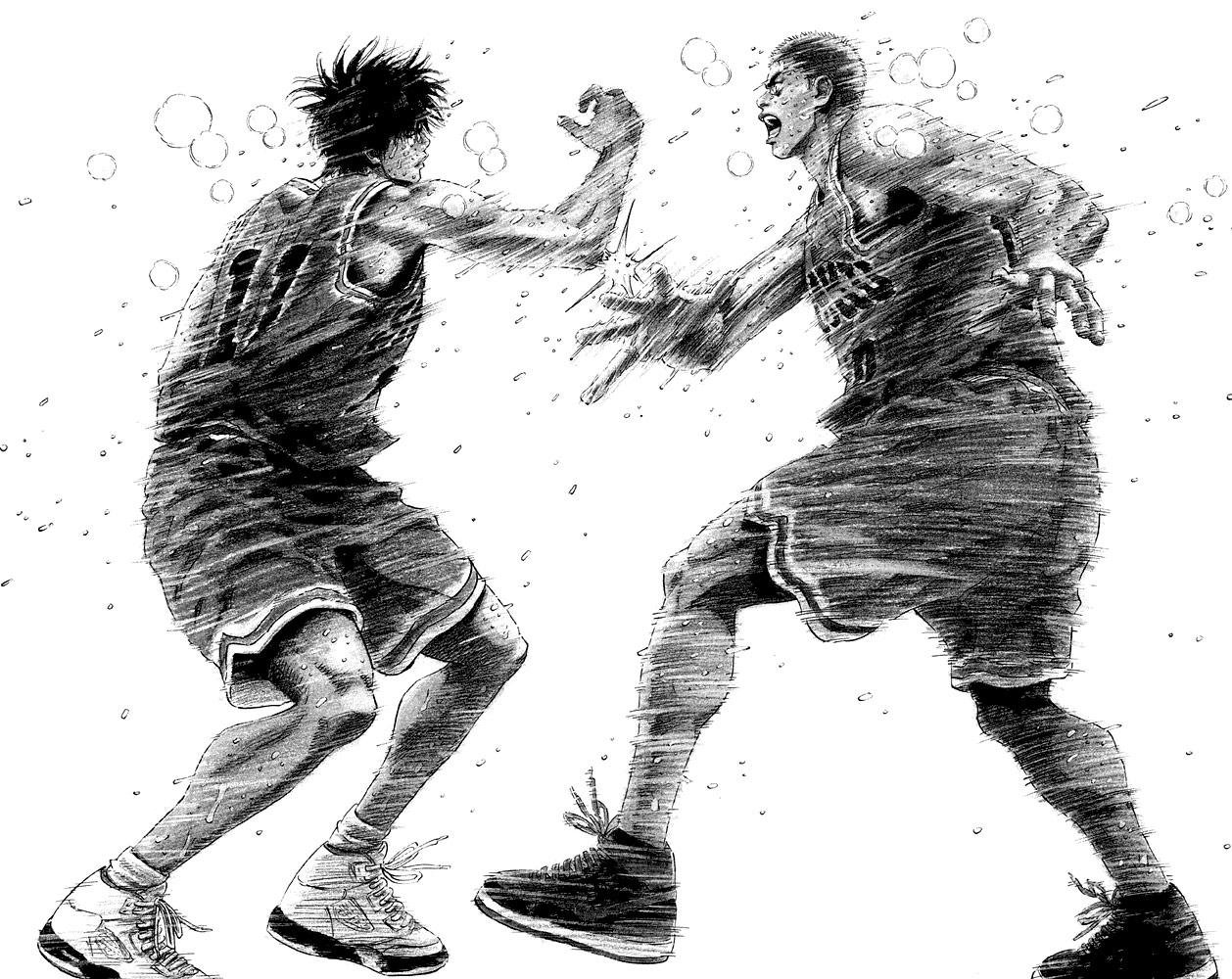
It's impossible to discuss Slam Dunk's greatness without acknowledging Takehiko Inoue's extraordinary artwork.
The manga begins with a relatively conventional early-1990s shonen appearance.
Its characters are expressive, its comedy is exaggerated, and its visual style is initially more concerned with personality than realism.
But as the story progresses, Inoue's artwork becomes increasingly sophisticated.
Bodies acquire weight.
Movements become more convincing.
Faces communicate exhaustion, determination, and fear with remarkable subtlety.
And the basketball matches gradually develop a visual language that feels almost cinematic.
One of Inoue's greatest abilities is controlling the passage of time.
A single possession can occupy multiple pages.
A few seconds can become an entire sequence of anticipation, movement, and emotional tension.
And rather than making the action feel slow, that attention to detail makes every movement seem enormously important.
You can practically feel the players' exhaustion.
The desperation of someone reaching for a rebound.
The uncertainty of a shot leaving a player's hands.
The overwhelming pressure of knowing that one mistake might destroy everything the team has worked toward.
But perhaps the most extraordinary example of Inoue's visual storytelling arrives during the final match against Sannoh.
As the game approaches its conclusion, the dialogue becomes increasingly sparse.
The artwork begins carrying nearly all the emotional weight.
Panels linger on movement.
Faces.
Hands.
Shoes against the court.
Players reacting to the smallest changes in possession.
The near-silence becomes almost deafening.
VIZ's retrospective on the final volume specifically praised the use of visual contrast and the increasingly minimal dialogue, recognizing how Inoue allowed the artwork to communicate the intensity of the final moments.
And it's difficult to imagine the conclusion working as effectively any other way.
Because after thirty-one volumes of laughter, arguments, shouting, and endless declarations of greatness, the manga allows the characters' actions to speak for themselves.
At the moment when everything matters most, Slam Dunk barely needs words.
Shohoku vs. Sannoh: The Greatest Moment of Their Lives
Everything culminates in Shohoku's match against Sannoh Kogyo.
The defending national champions.
A team whose reputation and abilities make them seem almost impossible to defeat.
For Shohoku, the challenge is enormous.
Their opponents are more experienced.
More disciplined.
And equipped with players capable of overwhelming even Shohoku's strongest members.
As the game progresses, the situation becomes increasingly desperate.
Sannoh builds a commanding lead.
Shohoku struggles against its defensive pressure.
The players become exhausted.
And for a while, it seems that the team has finally encountered an opponent it cannot overcome.
But this is where everything the manga has been developing begins to come together.
Sakuragi's rebounding becomes essential.
Mitsui continues contributing despite his exhaustion.
Miyagi fights to control the offense.
Akagi learns to trust his teammates.
Rukawa discovers the importance of passing rather than attempting to do everything himself.
Every character contributes something.
Every experience they've endured becomes part of the team's ability to keep fighting.
And slowly, impossibly, Shohoku begins closing the gap.
What makes the match extraordinary isn't simply the possibility of defeating the national champions.
It's the recognition that these five boys, who began as such different and frequently incompatible individuals, have finally become a genuine team.
They've argued.
They've fought.
They've insulted one another.
They've doubted each other.
Yet now, with everything on the line, they trust one another enough to pursue something that none of them could achieve alone.
And perhaps the most beautiful part is that this unity doesn't erase their individual personalities.
Sakuragi is still ridiculous.
Rukawa is still quiet and competitive.
Mitsui remains stubborn.
Akagi remains serious.
Miyagi remains spirited.
They haven't become completely different people.
They've simply learned how to become something greater together.
When Sakuragi Finally Understands That He Loves Basketball
One of the most emotionally important moments in the entire manga occurs when Sakuragi is forced to confront his feelings about the sport.
During the Sannoh game, he suffers a serious back injury while desperately trying to keep the ball in play.
The potential consequences are terrifying.
Continuing to play could make his condition worse.
His future as an athlete may be at risk.
And suddenly, everything changes.
For much of the series, Sakuragi has treated basketball as an opportunity to prove himself.
He wants recognition.
He wants admiration.
He wants to impress Haruko.
But now he's confronted with the possibility of losing the sport itself.
And in that moment, he finally understands something he hasn't been able to express honestly before.
He genuinely loves basketball.
Not because Haruko likes it.
Not because it makes him look impressive.
Not because he wants to defeat Rukawa.
He loves it because playing makes him happy.
Because the effort matters.
Because the people around him matter.
Because somewhere between his first embarrassing attempts and this extraordinary match, basketball has become something precious.
It's one of the most beautiful developments in any sports manga.
A boy who began playing for someone else's approval finally discovers something he wants for himself.
And that changes everything.
Sakuragi doesn't need basketball to prove that he's a genius anymore.
He wants to play because he loves it.
There's an enormous difference between those two motivations.
One depends upon other people recognizing your value.
The other comes from discovering value in the experience itself.
And it takes Sakuragi nearly the entire manga to understand that distinction.
A Victory That Doesn't Give Them Everything
The conclusion of the Sannoh match is extraordinary.
After everything Shohoku has endured, the outcome comes down to the final moments.
And in perhaps the most satisfying culmination of their rivalry, Rukawa passes the ball to Sakuragi.
The two players who have spent so much of the story competing for recognition finally trust one another when it matters most.
Sakuragi takes the shot.
The same boy who once struggled with basic basketball techniques.
The same boy who constantly boasted about being a genius while making ridiculous mistakes.
The same boy who had to spend countless hours practicing the fundamentals.
And he scores.
Shohoku defeats Sannoh.
The national champions have fallen.
For a brief moment, everything feels possible.
All the struggles.
All the disappointments.
All the years of effort.
They seem to have culminated in something extraordinary.
And when Sakuragi and Rukawa instinctively celebrate together, forgetting their rivalry for a fleeting moment, the emotional payoff is overwhelming.
But Slam Dunk doesn't end with Shohoku becoming national champions.
In fact, the story takes a much more surprising direction.
Shohoku loses its very next game.
After achieving the seemingly impossible against Sannoh, the team is defeated by Aiwa Academy in the following round.
The match itself isn't depicted in detail.
We're simply told the result.
And just like that, Shohoku's national championship journey is over.
No championship trophy.
No victory parade.
No final celebration in which every character's ambition is rewarded.
The greatest achievement of their high school basketball careers is immediately followed by defeat.
And there's something almost painfully realistic about that.
Because life doesn't always allow us to keep winning simply because we've accomplished something extraordinary.
Sometimes, the biggest victory of your life is followed by disappointment.
Sometimes, overcoming one seemingly impossible challenge doesn't mean you're guaranteed to overcome the next.
And sometimes, the moment you've spent years preparing for passes much more quickly than you expected.
The Bittersweet Ending of Slam Dunk
This is where Slam Dunk becomes something more than an extraordinary sports manga.
Because after everything we've experienced, the story doesn't offer the kind of conclusion we might naturally expect.
Akagi's time as Shohoku's captain comes to an end.
Kogure also moves toward life beyond the high school team.
Miyagi becomes the new captain.
Rukawa receives recognition through Japan's junior national team program.
Mitsui continues pursuing basketball, hoping to compete in the winter tournament.
And Sakuragi?
He's recovering from his back injury.
The protagonist who spent so much of the series declaring himself a genius doesn't end the manga standing triumphantly above everyone else.
He ends it undergoing rehabilitation.
His future remains uncertain.
We don't know exactly how far his basketball career will eventually take him.
We don't know whether he'll become the extraordinary player he believes he's capable of becoming.
And we don't get to follow every remaining step of his journey.
The story simply ends.
There's something incredibly bittersweet about that.
Because after spending thirty-one volumes with these characters, it almost feels unfair that their time together has passed so quickly.
We want more.
We want to see Sakuragi recover.
We want to watch him become an even better player.
We want to follow Rukawa as he faces stronger opponents.
We want Akagi's dedication to receive every reward it deserves.
We want Mitsui to make up for every year he lost.
And perhaps most of all, we want the Shohoku team to stay together.
But they can't.
Because they're teenagers.
And eventually, teenagers grow up.
The team that existed during that extraordinary summer cannot remain exactly the same forever.
Players graduate.
Responsibilities change.
New opportunities appear.
And the people who once shared the same gym every afternoon begin moving toward different futures.
The tragedy isn't that Shohoku failed to become national champions.
It's that the time these boys spent together was always going to end.
And perhaps that's why the conclusion feels so much like remembering your own adolescence.
The Days You Never Realized You Would Miss
There's something strange about looking back on your teenage years.
At the time, ordinary days rarely seem particularly important.
You go to school.
You spend time with friends.
You argue over ridiculous things.
You complain about responsibilities.
You look forward to weekends and holidays.
And you imagine all the things you'll accomplish once you're older.
But years later, those ordinary moments can become some of your most precious memories.
The people you saw every day are no longer part of your routine.
The places you once visited constantly become somewhere you only occasionally return.
The friendships that once felt permanent gradually change as everyone begins living different lives.
And sometimes, you find yourself wishing you could experience just one ordinary afternoon again.
Not because anything extraordinary happened.
But because you didn't realize how much that moment would eventually mean to you.
That's the feeling Slam Dunk captures so beautifully.
For the characters, basketball consumes almost everything.
Their practices matter.
Their rivalries matter.
Their victories and defeats matter.
They shout at each other.
They get angry.
They become exhausted.
And they spend countless hours chasing something that may never become reality.
But perhaps, years later, the memories they'll treasure most won't necessarily be the final scores.
Perhaps they'll remember the gym.
The sound of basketballs bouncing against the floor.
The teammates who drove them crazy.
The exhausting practices.
The stupid arguments.
The moment someone finally accomplished something nobody expected.
The feeling of belonging somewhere.
And the realization that, for a brief period in their lives, they were all working toward the same dream.
Sometimes, we don't recognize the happiest days of our lives until they've already become memories.
And Slam Dunk understands that with extraordinary tenderness.
Why Slam Dunk Is One of the Greatest Manga Ever Created
There are many excellent sports manga.
Some feature more elaborate techniques.
Some explore professional competition.
Others build their stories around increasingly extraordinary opponents and dramatic victories.
But Slam Dunk possesses something that transcends its genre.
It understands people.
It understands the arrogance of wanting to be admired.
The humiliation of discovering your limitations.
The regret of abandoning something you love.
The loneliness of pursuing an ambition nobody else understands.
The frustration of working hard without receiving the recognition you hoped for.
And the quiet happiness of discovering that the thing you originally pursued for entirely selfish reasons has become genuinely meaningful.
Every major character reflects a different relationship with those feelings.
Sakuragi wants recognition.
Akagi wants his dream to become reality.
Mitsui wants another opportunity to do what he loves.
Rukawa wants to challenge the limits of his abilities.
Miyagi wants to prove that his disadvantages don't determine his worth.
Kogure wants the years he dedicated to basketball to mean something.
And none of these desires is treated as insignificant.
They're young people trying to understand what their lives might become.
And for a brief moment, basketball gives all of them something worth believing in.
That's why the manga's final victory is so satisfying.
And why its subsequent defeat is so meaningful.
Because the value of their journey was never entirely dependent upon winning the national championship.
The friendships were real.
The effort was real.
The joy was real.
And the people they became through that experience were real.
Even if the ultimate dream remained unfulfilled.
The Beautiful Imperfection of Youth
Perhaps the most important thing Slam Dunk teaches us is that growing up doesn't mean becoming the extraordinary person you once imagined.
Sometimes, it means accepting that you're not the best.
That someone else possesses abilities you don't.
That effort won't always be rewarded with victory.
That opportunities can disappear.
And that even the most important chapters of your life eventually come to an end.
But growing up also means discovering new reasons to be happy.
Finding something you genuinely love.
Learning to appreciate people who are different from you.
Understanding that your worth isn't determined entirely by recognition or achievement.
And realizing that a dream doesn't have to come true for the time you spent pursuing it to have mattered.
Sakuragi begins the manga desperately wanting everyone to acknowledge that he's a genius.
But by the end, something has changed.
He doesn't need to convince himself that basketball matters.
He knows it does.
He loves the sport.
He values his teammates.
And despite everything he's experienced, he's determined to return.
That's a remarkable transformation.
Not because he became the best player in Japan.
Not because he won the national championship.
But because he discovered something worth continuing to live and work for.
And perhaps that's a more meaningful achievement than either of those things.
An Ending That Feels Like Saying Goodbye to Your Youth
When Slam Dunk ends, there's no overwhelming sense that everything has been resolved.
And perhaps that's intentional in the storytelling, even if the manga doesn't explain every character's future.
Because adolescence rarely offers a perfect conclusion.
You don't necessarily recognize the last time you'll spend an afternoon with a particular group of friends.
You don't always realize when a familiar routine is about to disappear.
And you rarely know whether the ambitions you hold today will still matter to you ten years later.
Life simply continues.
People move forward.
And the moments that once seemed like the center of your entire existence gradually become part of your past.
But their significance doesn't disappear.
The fact that Shohoku never becomes national champion doesn't make its victory over Sannoh meaningless.
The fact that Akagi's high school career ends doesn't erase the years he dedicated to his dream.
The fact that Mitsui cannot recover his lost time doesn't invalidate his decision to return.
And the fact that Sakuragi's future remains uncertain doesn't diminish everything he's accomplished.
Those experiences mattered.
Even if they didn't last forever.
Perhaps that's what makes Slam Dunk so incredibly beautiful.
It doesn't simply celebrate the excitement of youth.
It captures the sadness of knowing that youth is temporary.
For a brief moment, these boys believed they could accomplish something extraordinary together.
And for one unforgettable game, they did.
But the world continued afterward.
Their lives continued.
And eventually, they had to leave that moment behind.
Just as we all do.
That's why Slam Dunk remains one of the greatest manga ever created.
Not merely because of its breathtaking basketball matches, unforgettable characters, or extraordinary artwork.
But because it understands something fundamental about growing up.
We spend so much of our youth dreaming about who we might become that we sometimes fail to appreciate who we are while we're still becoming them.
And when those years finally pass, we realize that the journey itself was something precious.
Something we can never experience in quite the same way again.
Slam Dunk isn't simply a story about winning at basketball.
It's a story about being young enough to believe you could become anything, and growing up enough to understand that the person you became along the way matters just as much.
And perhaps that's why its ending stays with us.
Because Shohoku's greatest summer eventually ended.
Because not every dream came true.
Because the people who meant everything to one another had to begin moving toward different futures.
But for a little while, they were together.
They played basketball.
They chased something extraordinary.
And they experienced moments that would remain part of their lives forever.
They didn't win everything.
But what they experienced was worth everything.
And sometimes, that's enough.