There is something magical about being young and believing the entire world is waiting for you. Masaaki Yuasa's Ping Pong the Animation captures that feeling, along with the heartbreaking realization that not every dream will come true, and the beautiful discovery that life doesn't end when they don't.
There was a time when the future seemed limitless.
When you were young enough to believe that if you wanted something badly enough, worked hard enough, and never gave up, you could become anything.
A professional athlete. A famous musician. An extraordinary artist. Someone whose name the entire world would recognize.
Back then, those possibilities didn't necessarily feel unrealistic.
They were simply waiting for you.
And perhaps that is one of the most bittersweet things about growing older.
You begin to realize that not every path remains open forever.
Some dreams become realities. Others slowly disappear. Some are abandoned because they no longer feel worth pursuing, while others remain painfully out of reach no matter how much effort you put into them.
It's a universal experience, yet surprisingly few stories capture it with the sincerity of Ping Pong the Animation.
Released in 2014, this 11-episode anime directed by Masaaki Yuasa and produced by Tatsunoko Production adapts Taiyo Matsumoto's manga about a group of teenage table tennis players.
On the surface, it appears to be another sports anime about talented competitors struggling to become the best.
But Ping Pong is something considerably more profound.
It's a story about youth.
About ambition, talent, friendship, disappointment, and discovering what truly matters to you.
It's about the intoxicating feeling that your dreams might actually come true.
And the painful realization that sometimes, they won't.
But above all, it's about understanding that even when your dreams change, the time you spent chasing them was never wasted.
The World Belongs to You When You're Young
At the center of Ping Pong the Animation are two childhood friends.
Yutaka Hoshino, better known as Peco, and Makoto Tsukimoto, nicknamed Smile.
Both are exceptionally talented table tennis players attending Katase High School.
But their personalities couldn't be more different.
Peco is loud, confident, energetic, and completely convinced of his own greatness.
He loves table tennis, but his natural ability has also made him somewhat arrogant.
Practice doesn't interest him nearly as much as the excitement of playing.
Why should he worry about training when he's already so good?
Smile, meanwhile, is quiet, withdrawn, and seemingly indifferent to almost everything around him.
Despite possessing remarkable talent, he rarely demonstrates much interest in becoming a champion.
His nickname is almost ironic.
He hardly ever smiles.
Yet beneath their differences lies a friendship that began when they were children.
For Smile, Peco has always been something of a hero.
The person who introduced him to table tennis, protected him from bullies, and gave him a reason to enjoy something.
For Peco, the game represents freedom, excitement, and the possibility of becoming someone extraordinary.
But as they grow older and encounter increasingly talented opponents, both boys are forced to confront something they never fully understood as children.
The world is much bigger than they imagined.
And being talented doesn't necessarily mean being the best.
The Moment You Realize You Might Not Be Special
One of the most painful experiences of adolescence is discovering that something you're proud of doesn't necessarily make you exceptional.
Perhaps you were the fastest runner in your school.
The best player among your friends.
The person everyone complimented for being naturally gifted.
For years, you might have believed you possessed something extraordinary.
Then one day, you meet someone better.
Someone who accomplishes effortlessly what you've spent years trying to achieve.
And suddenly, the confidence you've built around your abilities begins to collapse.
This is precisely what happens to Peco.
Early in the series, he encounters Kong Wenge, a talented Chinese player attending Tsujido Academy.
Kong was once involved in China's elite table tennis system but has been sent to Japan after failing to maintain his place.
For him, Japan initially represents an unwelcome detour from the future he wanted.
For Peco, however, their encounter becomes a devastating reminder that his natural talent has limits.
He is thoroughly outclassed.
Later, another defeat against his childhood acquaintance Manabu Sakuma, known as Akuma, damages his confidence even further.
The boy who once seemed completely certain of his destiny suddenly struggles to believe in himself.
And that's what makes Peco's downfall so effective.
He isn't simply upset because he lost a match.
He's confronting the possibility that the future he imagined might never happen.
That perhaps he isn't the extraordinary player he believed himself to be.
That the world might continue turning without ever recognizing his greatness.
It's a deeply adolescent fear.
And a painfully human one.
Because when you've spent years imagining yourself becoming someone extraordinary, accepting the possibility of an ordinary future can feel like losing a part of yourself.
The Cruel Difference Between Talent and Hard Work
If Peco represents the danger of taking natural talent for granted, Akuma represents something even more heartbreaking.
The realization that hard work doesn't guarantee success.
Manabu Sakuma isn't presented as an exceptional prodigy.
He doesn't possess the effortless ability of players like Peco or Smile.
But he trains relentlessly.
He studies his opponents, practices obsessively, and dedicates enormous effort to improving.
He wants to become stronger.
He wants to stand alongside the people he admires.
And for a while, his effort pays off.
His victory over Peco is significant precisely because he's managed to overcome someone whose natural ability once seemed far beyond his reach.
But Akuma eventually encounters a much harsher reality.
Against Smile, his determination isn't enough.
The gap between their abilities becomes painfully obvious.
For someone who has invested so much of his identity into improving, it's a devastating experience.
And this is where Ping Pong distinguishes itself from more conventional inspirational sports stories.
Many anime celebrate the idea that sufficient determination can overcome any obstacle.
Train harder.
Believe in yourself.
Never surrender.
And eventually, victory will be yours.
It's a wonderful message.
But it isn't always true.
Sometimes, you can dedicate years of your life to something and never become the best.
Someone else might possess advantages you cannot overcome.
You might reach the limits of your abilities.
And no amount of determination can guarantee the future you imagined.
Ping Pong doesn't treat this realization as proof that Akuma's efforts were meaningless.
Instead, it challenges the assumption that an unfulfilled ambition must define someone's entire existence.
You can give everything you have to a dream and still fail to achieve it. That doesn't mean your life has failed.
It's a difficult lesson.
Especially when you're young.
But it's also one of the most important.
Growing Up Means Discovering That Dreams Can Change
Perhaps what makes Ping Pong the Animation so emotionally mature is that it doesn't insist every character must follow the same path.
Peco wants to become an extraordinary player.
Smile possesses the talent to pursue that ambition but doesn't necessarily share it.
Akuma discovers the limits of his competitive potential.
Kong must confront the possibility that his original dream of returning to China's elite system may no longer be attainable.
And Ryuichi Kazama, the formidable player known as Dragon, struggles beneath the enormous expectations placed upon him.
Every character has a different relationship with the sport.
For some, table tennis represents personal freedom.
For others, it's an obligation.
A path toward recognition.
A source of pride.
Or the one thing that gives their lives a sense of direction.
And that's what makes their conflicts so compelling.
They're not merely competing to determine who's the strongest player.
They're trying to understand who they want to become.
Consider Kong.
When he first arrives in Japan, he carries an overwhelming sense of disappointment.
He wants to return home.
He wants another opportunity to prove himself.
And he struggles to accept the circumstances that brought him into an unfamiliar country.
But gradually, something begins to change.
He develops relationships with his Japanese teammates.
He becomes invested in their improvement.
He discovers that table tennis can be meaningful beyond his original ambition.
One of the series' most beautiful moments occurs during its Christmas sequence, when Kong joins his teammates in singing karaoke.
It's such a simple scene.
No championship.
No extraordinary victory.
Just a group of young people spending time together.
Yet it feels enormously significant.
Because for perhaps the first time, Kong's life in Japan begins to represent something more than failure.
He has found people who matter to him.
A place where he belongs.
And possibilities he never originally intended to pursue.
His dream hasn't simply vanished.
It's changed.
And sometimes, growing up means discovering that the life you never planned can become just as meaningful as the one you once imagined.
When the Thing You Love Becomes a Burden
Ryuichi Kazama offers another fascinating perspective on ambition.
Known as Dragon, he's an incredibly disciplined and accomplished player.
He trains relentlessly and carries himself with the seriousness of someone whose entire existence revolves around competition.
To an outsider, he might appear to possess everything a young athlete could want.
Recognition.
Respect.
Extraordinary ability.
A future built around the sport he has spent years mastering.
But beneath that success lies tremendous pressure.
Kazama's relationship with table tennis is intertwined with his family, its expectations, and the painful history surrounding his father.
Winning becomes more than a personal ambition.
It becomes a responsibility.
A means of proving his worth.
And as those expectations accumulate, the joy of playing begins to disappear.
This is one of the most uncomfortable truths Ping Pong explores.
Sometimes, the thing you love most can become the very thing that makes you miserable.
An enjoyable hobby can turn into an obligation.
A dream can become a source of anxiety.
Something that once made you feel free can begin to feel like a prison.
Kazama hasn't necessarily lost his ability.
He's lost the freedom to enjoy it.
And perhaps that is even more tragic.
Because what good is becoming extraordinary at something if the experience brings you nothing but fear and pressure?
Ping Pong doesn't suggest that ambition is inherently harmful.
But it recognizes how easily the desire to succeed can overwhelm the original reason we wanted to succeed at all.
Which brings us back to Peco.
And to what might be the most beautiful idea in the entire series.
The Hero Isn't the Strongest Player. He's the One Who Remembers Why He Plays.
Throughout Ping Pong the Animation, the idea of a hero appears repeatedly.
Smile believes that a hero will eventually arrive.
Someone capable of breaking through the emotional barriers he has built around himself.
Someone who can remind him of the happiness he once experienced.
And that person is Peco.
Not because he's an unbeatable champion.
Not because he's destined to become the greatest table tennis player in history.
But because he possesses something that the other characters have gradually forgotten.
The ability to enjoy playing.
For all his arrogance and immaturity, Peco's greatest strength has always been his genuine love of the game.
When he plays at his best, he isn't calculating his worth as a human being.
He isn't trying to satisfy some enormous responsibility.
He isn't consumed by the fear of disappointing everyone.
He's simply playing table tennis.
And having the time of his life.
That's what makes his eventual comeback so exhilarating.
After losing his confidence and abandoning the sport, Peco slowly rediscovers the passion that made him extraordinary in the first place.
He trains seriously.
He confronts his weaknesses.
And he begins understanding that natural ability alone isn't enough.
But crucially, he doesn't abandon the joy that originally brought him to the table.
He learns to combine discipline with genuine enthusiasm.
And when he finally confronts Dragon, that joy becomes transformative.
The match isn't memorable simply because Peco manages to defeat an exceptionally powerful opponent.
It's memorable because his passion begins affecting Dragon himself.
For someone who has spent so long treating table tennis as an enormous burden, experiencing an opponent who plays with such unrestrained happiness becomes liberating.
For a moment, Dragon is no longer simply carrying the weight of expectations.
He's playing a game.
And enjoying it.
The hero doesn't simply defeat his opponent. He reminds him why he fell in love with the sport in the first place.
That is what makes Peco special.
And it's what makes Ping Pong so much more than a conventional sports anime.
Smile: The Boy Who Needed Someone to Bring Him Back to Life
While Peco's journey involves rediscovering his passion, Smile's journey is about rediscovering something even more fundamental.
His humanity.
From the beginning, Smile appears emotionally detached.
He rarely expresses enthusiasm, suppresses his feelings, and approaches situations with an almost mechanical indifference.
The series frequently depicts him imagining himself as a robot.
Someone who doesn't need emotions.
Someone who can avoid being hurt by keeping the world at a distance.
And in many ways, his remarkable table tennis ability becomes another extension of that identity.
He can analyze opponents.
Respond precisely.
Play with extraordinary efficiency.
But he struggles to experience the genuine happiness that the sport once gave him.
His coach, Jo Koizumi, recognizes his incredible potential and attempts to push him toward becoming an elite player.
Yet the more Smile develops his abilities, the clearer it becomes that technical excellence isn't necessarily what he needs most.
He doesn't simply need to become stronger.
He needs to remember how to feel.
And that's where Peco becomes essential.
When they were children, Peco introduced Smile to a world beyond his isolation.
He gave him companionship.
Something to enjoy.
Someone to admire.
And although their relationship changes as they grow older, Smile continues waiting for the return of the person who made his childhood brighter.
That is the deeper meaning behind the recurring idea of the hero.
Smile isn't waiting for someone to defeat every opponent.
He's waiting for the friend who once made him happy.
And when that friend finally returns, the effect is extraordinary.
In the director's official commentary published after the series won a Tokyo Anime Award Festival prize, Masaaki Yuasa explained that he understood Smile's journey as a robot-like person recovering his humanity.
Peco doesn't deliberately set out to rescue him.
His genuine enjoyment of table tennis simply allows Smile to rediscover emotions he had buried.
That interpretation makes their relationship even more moving.
Because sometimes, the people who save us aren't trying to be heroes. They're simply sharing something beautiful with us.
And sometimes, that's enough.
An Art Style That Feels Like Being Young
It would be impossible to discuss Ping Pong the Animation without acknowledging its extraordinary presentation.
At first glance, the series looks almost unfinished.
Its character designs are rough.
Faces distort.
Bodies stretch into unusual proportions.
Movement often ignores the polished consistency associated with more conventional anime productions.
But that's precisely what makes it so remarkable.
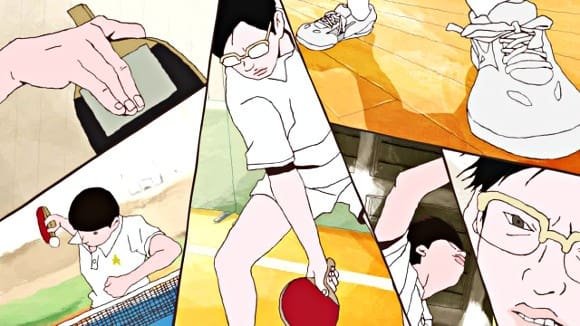
Director Masaaki Yuasa embraces the expressive possibilities of animation rather than attempting to reproduce realistic movement at every opportunity.
Characters become distorted by the intensity of their emotions.
The perspective shifts dramatically during matches.
The screen divides into multiple panels, allowing different actions and reactions to unfold simultaneously.
Table tennis becomes something almost otherworldly.
Not because the players possess supernatural abilities, but because the animation captures how extraordinary the experience feels to them.
A rally isn't simply two people hitting a ball.
It's a collision of ambition, fear, confidence, desperation, and excitement.
The matches feel alive.
And there's something about the roughness of the artwork that complements the series' coming-of-age themes.
These characters aren't polished, perfectly formed individuals.
They're teenagers.
Uncertain about themselves.
Still discovering their identities.
Still making mistakes.
Still trying to understand what kind of people they want to become.
The animation feels just as restless as they are.
It rarely settles into something comfortable or predictable.
And that creates a fascinating harmony between the story's subject matter and its visual presentation.
Even more impressive is the soundtrack by Kensuke Ushio.
His music gives the matches an infectious sense of momentum while allowing the quieter moments to carry enormous emotional weight.
Combined with the energetic opening theme, Tada Hitori by Bakudan Johnny, the series creates an atmosphere that feels inseparable from its youthful characters.
There's exhilaration.
There's uncertainty.
There's melancholy.
And there's the almost overwhelming sensation that something extraordinary might be waiting just beyond the next match.
It's the sound and feeling of adolescence.
The Final Match: When Winning Stops Being the Most Important Thing
The conclusion of Ping Pong the Animation is one of the most beautiful endings in sports anime.
After everything they've experienced, Peco and Smile finally face one another in the tournament final.
The match represents the culmination of their individual journeys.
Peco has rediscovered his confidence and passion.
Smile has developed his extraordinary abilities but remains emotionally guarded.
And now, after years of friendship, the two boys stand on opposite sides of the table.
In a conventional sports story, the central question might be obvious.
Who will win?
Which player will prove himself superior?
Who will finally become the champion?
But Ping Pong approaches the moment differently.
Because the actual outcome is almost secondary to what happens between the characters.
For Smile, the return of his childhood hero allows him to experience something he has been missing for years.
Joy.
The defensive identity he constructed around himself begins to disappear.
The boy who imagined himself as an emotionless machine finally allows himself to feel again.
And the person who makes that possible is the same friend who first introduced him to the sport.
The story comes full circle.
In the anime's official production commentary, Yuasa explained that the emotional climax arrives almost as soon as Peco and Smile finally reunite at the table.
What matters most has already happened.
The hero has returned.
The boy who stopped smiling can finally smile again.
And everything that follows becomes a celebration of that realization.
The series even incorporates a montage of the characters as children, reminding us that before they became talented athletes, bitter rivals, or people burdened by expectations, they were simply kids enjoying something.
There's something devastatingly beautiful about that sequence.
Because for a brief moment, all the pressure disappears.
The rankings don't matter.
The disappointments don't matter.
The uncertainty of the future doesn't matter.
They're young again.
And playing a game they love.
The Bittersweet Reality of Becoming an Adult
Perhaps the most emotionally significant part of Ping Pong the Animation arrives after the main competition has ended.
The story moves forward several years, showing what became of its characters.
And their futures aren't identical.
Peco continues pursuing professional table tennis, playing overseas and representing the realization of the enormous potential he displayed as a child.
Kong builds a future in Japan, eventually competing internationally for his adopted country.
Kazama continues playing, but his relationship with success and failure has changed.
Akuma moves toward a life outside elite table tennis.
And Smile?
The boy whose extraordinary abilities once made him a potential champion doesn't pursue the same professional future as Peco.
Instead, he finds fulfillment teaching children and continuing his connection to table tennis.
And he seems happy.
That simple detail might be the most important message in the entire series.
Because Smile didn't fail.
He didn't become a wasted talent simply because he chose a different life.
He discovered what mattered to him.
For Peco, happiness meant pursuing the excitement of competition at the highest level.
For Smile, it meant finding connection, joy, and purpose without needing to prove he was the strongest.
And neither choice invalidates the other.
That's what growing up actually looks like.
Not everyone becomes the person they imagined at fifteen.
Some people achieve extraordinary success.
Others discover that the dreams they once cherished no longer interest them.
Some find happiness in careers they never considered.
Others simply learn to appreciate a quieter life.
And none of these outcomes automatically determines whether a life was worthwhile.
Perhaps the saddest thing about adolescence is that it cannot last forever.
There is only so much time to be that version of yourself.
The teenager who believed every door was still open.
The kid who thought that becoming the best player in the world was simply a matter of trying hard enough.
The young person who hadn't yet learned how complicated life could become.
Eventually, that version of you disappears.
But perhaps the beautiful part is that something else takes its place.
Someone who understands themselves better.
Someone who has experienced disappointment but also discovered unexpected happiness.
Someone who realizes that life can remain meaningful even when it doesn't resemble the future they once imagined.
That's the bittersweet beauty of Ping Pong.
It celebrates the extraordinary possibilities of youth without pretending those possibilities will remain limitless forever.
The Dream Might End, but the Love Doesn't Have To
There's a particularly moving distinction between giving up on a dream and giving up on something you love.
They aren't necessarily the same thing.
You might dream of becoming a professional musician and never achieve that career.
But you can still love playing music.
You might spend your teenage years wanting to become a professional athlete, only to discover that your abilities won't take you that far.
But you can still enjoy the sport.
You might abandon an ambition that once defined your entire identity, then discover that it was never the only thing capable of making you happy.
Ping Pong understands that distinction better than most stories.
For its characters, table tennis represents different things at different points in their lives.
A competition.
An obligation.
A childhood memory.
A source of friendship.
A dream.
And eventually, something that can continue existing even after those original ambitions have changed.
That's what makes Smile's ending so meaningful.
He doesn't need to become a world champion to preserve the joy that table tennis gave him.
He can share that experience with other children.
He can become for someone else a little of what Peco once was for him.
And perhaps those children will develop dreams of their own.
Perhaps some will become extraordinary players.
Perhaps others will eventually pursue completely different lives.
But the joy of discovering something they love will still have mattered.
The important thing isn't necessarily how far that passion takes them.
It's that they experienced it.
You don't have to become the greatest at something for your love of it to have been real.
Why Ping Pong the Animation Is So Beautiful
What makes Ping Pong the Animation extraordinary is that it manages to be both inspiring and painfully realistic.
It tells us that dreams are worth chasing.
That talent means little without commitment.
That friendships can change our lives.
And that rediscovering the joy in something we love can be more meaningful than achieving recognition.
But it also acknowledges that effort doesn't guarantee victory.
That some people will never reach the level they once imagined.
That certain opportunities disappear with age.
And that growing up sometimes means accepting an entirely different future.
Yet despite those harsh realities, the series never feels hopeless.
Quite the opposite.
There's an overwhelming warmth beneath its competition and disappointment.
Every character is trying to find their place in the world.
Some succeed in the ways they originally imagined.
Others discover happiness somewhere entirely unexpected.
And as the story concludes, we're left with the sense that their lives are only beginning.
Not because every dream will eventually come true.
But because there is still so much life waiting beyond those dreams.
That is what makes the series such a remarkable coming-of-age story.
It's about the excitement of discovering what you might become.
The fear of discovering what you might never become.
And the quiet happiness of eventually finding out who you actually want to be.
A Love Letter to the Dreams We Had When We Were Young
Maybe that's why Ping Pong the Animation can feel so nostalgic, even if you've never played table tennis in your life.
Because almost everyone remembers what it was like to dream.
To believe that the world was filled with possibilities.
To imagine an extraordinary future without fully understanding how difficult reaching it might be.
And perhaps, somewhere along the way, you experienced that first painful realization that things wouldn't necessarily turn out as you'd hoped.
Maybe you stopped pursuing a childhood ambition.
Maybe you discovered someone who was better at the thing you loved most.
Maybe you simply grew older and found that the person you wanted to become no longer resembled the person you actually were.
Those experiences can feel like losses.
And sometimes, they are.
But Ping Pong reminds us that they don't have to be the end of something meaningful.
Because the hours you spent practicing weren't wasted.
The friendships you made weren't meaningless.
The excitement you felt when you imagined your future was real.
Even if that future never arrived.
And perhaps one day, you'll rediscover a little of that excitement in something completely different.
A new passion.
A different dream.
An ordinary moment that unexpectedly makes you happy.
Ping Pong the Animation isn't simply about believing you can achieve your dreams.
It's about discovering that life can still be beautiful even when you don't.
And somehow, that makes its celebration of youth even more powerful.
Because while we can't remain young forever, we don't have to abandon everything that made being young so wonderful.
The desire to discover.
The courage to try.
The excitement of finding something we love.
The joy of sharing that feeling with another person.
Those things can stay with us.
Long after the tournaments end.
Long after the dreams change.
Long after the people we once were have become memories.
And perhaps that's the most beautiful thing Ping Pong leaves behind.
You might not become everything you once dreamed of being.
But that doesn't mean you can't become someone happy.